 NorthWest Wa
Footbag · Beginners
Footbag for beginners
Who it's for: anyone who has never kicked a footbag, or hasn't since school, and wants a simple way to move for 10 minutes. All it takes is one bag, a pair of shoes and a flat patch of ground.
Get the skills ladder Free printable PDF, 2 pages, 308 KB. No sign-up.
What footbag is
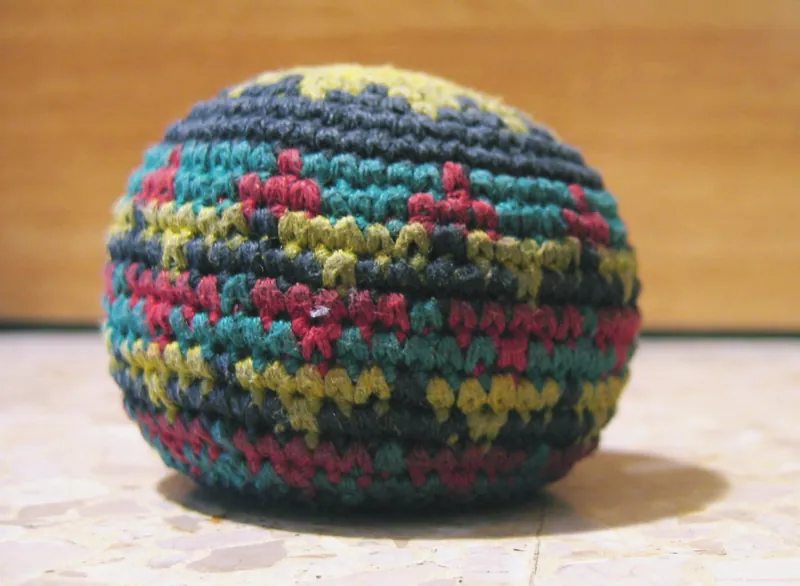
A footbag is a small, soft bag, usually filled with plastic pellets or sand, that you kick to keep in the air. The most common game is a circle: two or more people stand in a ring and keep the bag off the ground for as long as they can, without using their hands. The modern game began in 1972 in Oregon City, Oregon, where Mike Marshall and John Stalberger made their first bags. People often call it hacky sack, after the brand of footbag they sold.
Older cousins in Japan and Asia
Kicking games like this are far older. In Japan, kemari (蹴鞠) was a court game of the Heian period. Players work together to keep a deerskin ball in the air without using their hands. Records show games played in 701. Today kemari is played as a seasonal event at shrines around Kyoto and the Kansai region. Similar games include jianzi in China, đá cầu in Vietnam and sepak takraw in Southeast Asia. In August 2026, the World Footbag Championships were held in Tsukuba, Japan. It was the first time the event was held in Asia.
Your first 10 minutes
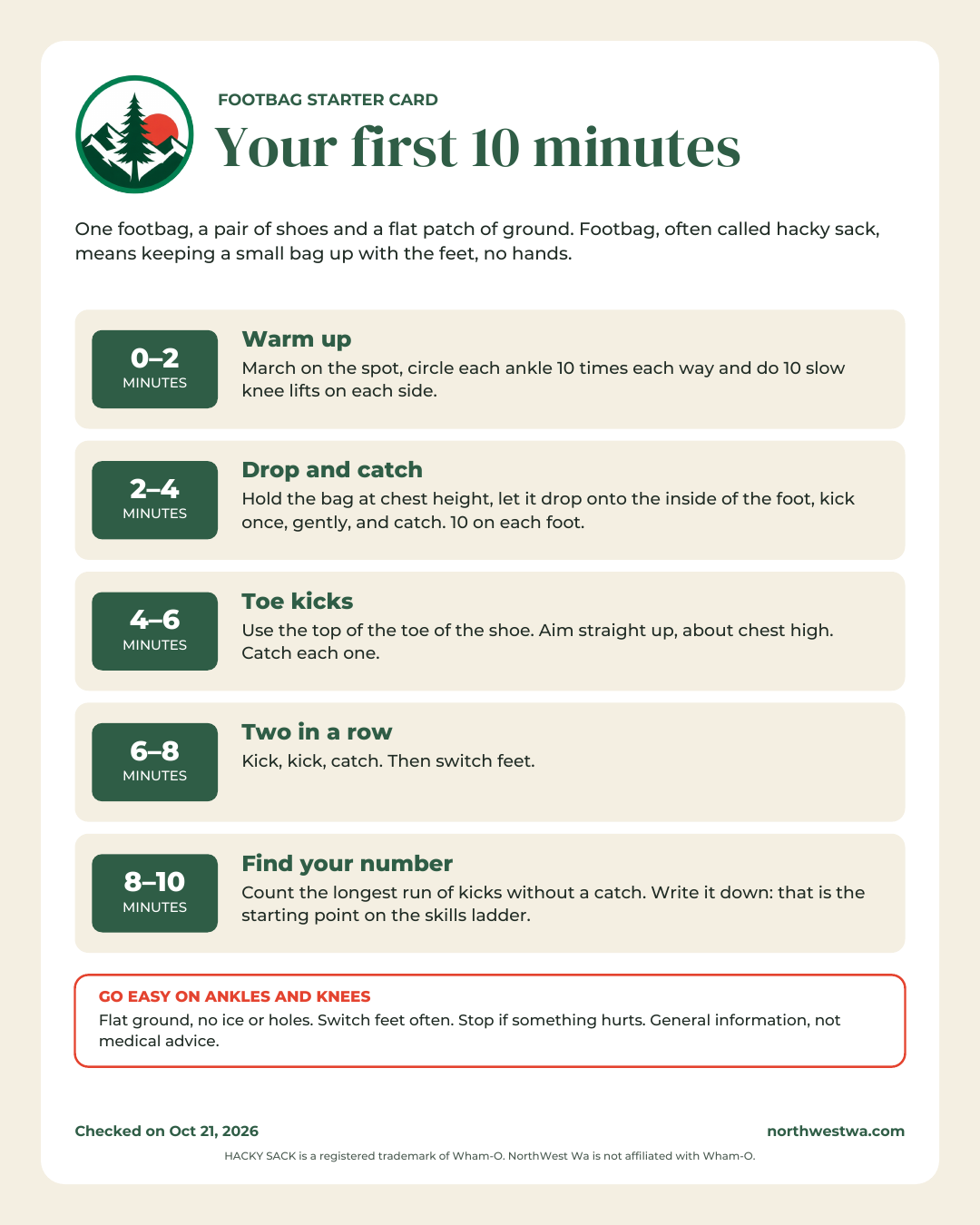
- Minutes 0–2: warm up. March on the spot, circle each ankle 10 times each way, and do 10 slow knee lifts on each side.
- Minutes 2–4: drop and catch. Hold the bag at chest height, let it drop onto the inside of your foot, kick it once, gently, and catch it. Do 10 on each foot.
- Minutes 4–6: toe kicks. Same as above, but use the top of the toe of your shoe. Aim straight up, about chest high. Catch each one.
- Minutes 6–8: two in a row. Kick, kick, catch. Then switch feet.
- Minutes 8–10: your number. Count your longest run of kicks without catching. Write it down. That's your starting point on the skills ladder.
Print your first 10 minutes (PDF, 1 page, 303 KB)
The four basic kicks
These steps are for a right-footed kicker. Practise both feet equally from day one.
- Inside kick. Turn your hips about 45 degrees toward your kicking foot and lift that foot in front of your other leg, so the inside of the foot is flat and faces up. Meet the bag with the middle of the instep and send it straight up.
- Toe kick. Lift your knee, keep your foot nearly flat and flick the bag straight up with the top of the toe of your shoe. Keep the ankle loose.
- Outside kick. Let the bag drop slightly out to your side. Turn your hips away and meet the bag with the outer edge of your foot. It's useful for saving a bag that drifts wide.
- Knee kick. Lift your knee to meet the bag just above the kneecap and pop it gently back up. It works well in a casual circle. In footbag net, any touch at the kneecap or higher is a foul.
Tip: Aim for soft, straight-up kicks about chest height. A high or hard kick is harder to control.
Stalls: the next step
A stall means catching the bag on your foot and holding it for a moment. Instead of kicking up, move your foot down at the same speed as the falling bag, so it lands softly. Most freestyle tricks start and end on a stall. See the skills ladder for where stalls fit.
Warm up and look after your joints
Footbag is low-impact, but it asks a lot of your ankles, knees and hips.
- Warm up for a few minutes first, and ease in after time off.
- Play on a flat surface with no holes, loose gravel, ice or wet leaves.
- Wear shoes that fit well and grip the ground.
- Switch feet often so one side doesn't do all the work.
- Stop if something hurts, and rest. If pain keeps coming back, talk to a health professional.
- Pellet-filled bags are small. Keep them away from very young children and check the age label on the product.
This page is general information, not medical advice.
Circle manners
- Serve the bag gently to someone else's chest or knees, not to yourself.
- If you drop it, you pick it up.
- Don't use your hands once the bag is in play.
- Keep kicks soft and toward the circle. Shots at other players are only for games everyone has agreed to.
- When the bag has touched every player once before it hits the ground, it's often called a "hack".
More for new players: Skills ladder (coming soon) · Styles of play (coming soon) · Clubs and events in Canada · How to pick a footbag (coming soon)
Checked on Oct 21, 2026.
Sources
- Wikipedia: Footbag
- Wikipedia: Kemari, which cites Kokugakuin University
- Footbag Foundations: basic kicks and stalls
- IFPA Official Rules, Article III, 303.09-H
- footbag.org: World Footbag Championships 2026 event listing
- World Footbag Championships 2026 organizing committee: press release, Aug 17, 2026 (Japanese)