 NorthWest Wa
Disc golf · Beginners
Disc golf for beginners
Who it's for: anyone in Edmonton or elsewhere in Alberta who has never thrown a golf disc, plus families and friends who want an easy, low-cost day outside.
A short history
People were tossing flying discs at trees and lamp posts almost as soon as the Frisbee appeared in 1957, in many places at once and mostly without knowing about each other. The game got organized in the 1970s. In 1975 Ed Headrick, a Wham-O executive now known as the "Father of Disc Golf", put in the first permanent course at Oak Grove Park in Pasadena, California, with plain poles as targets. Chain baskets soon replaced the poles. Headrick founded the Professional Disc Golf Association (PDGA) in 1976 and patented the Disc Pole Hole basket in 1977. Most baskets today still follow that design.
Why so many people play
The idea is the same as golf: get from the tee to the target in as few throws as you can. Many courses sit in public parks and cost nothing to play. One disc is enough to start, and a casual round takes an hour or two. People of every age can play together, each at their own pace, which makes it a good fit for a family afternoon. The sport has grown fast. In 2020, Canadian PDGA membership rose by more than 30%, and Encyclopaedia Britannica now counts more than 15,000 courses worldwide.
The four disc types
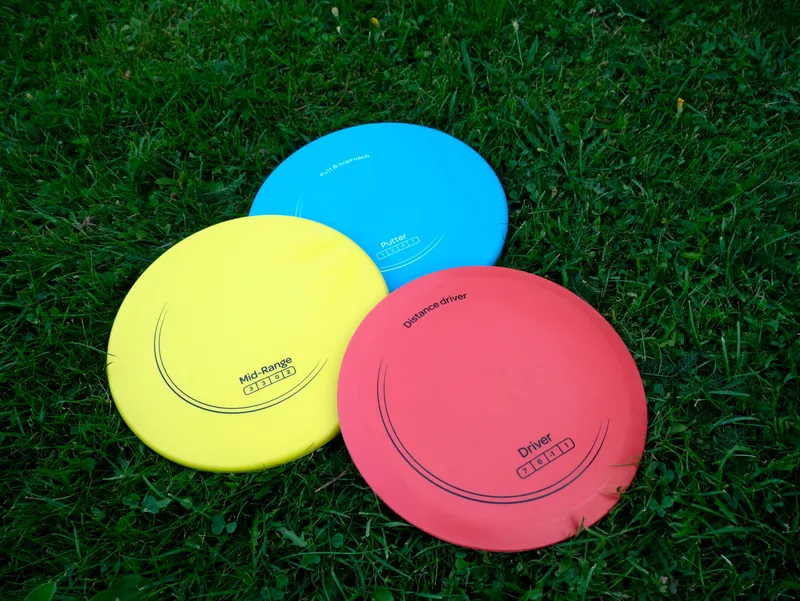
Golf discs are smaller and heavier than a backyard Frisbee. They come in four main types, from slowest to fastest:
- Putter. Deep, round-edged and slow. It flies straight and is made for short throws into the basket. It also works for short throws off the tee.
- Midrange. A slightly sharper edge. It gives controlled, fairly straight throws at middle distances, and it can do almost every job on the course.
- Fairway driver. Sharper and faster than a midrange, but still easy to control. It's good for longer, straighter shots.
- Distance driver. The widest rim and the sharpest edge. It has the most range, but only for a fast, practised arm.
Many discs carry a speed number. On the PDGA's scale, putters are about 1 to 3, midranges 4 to 5, fairway drivers 6 to 8, and distance drivers 9 and up.
Lighter and slower first
A fast driver doesn't add distance until your arm is fast enough to throw it. Thrown too slowly, it dives out of the air early, so new players are often surprised when their putter flies farther than their driver. Start with a putter and a midrange, add a fairway driver next, and save distance drivers for later.
Light discs are easier to get moving. The PDGA's youth guide suggests about 140 grams or less for players under 12, around 150 grams from age 13, and nothing heavier than 165 grams for beginners. Lighter discs drift more in the wind, so expect that on breezy days.
For kids: a light putter or midrange is enough. Golf discs are sports gear, not toys, and they can hurt. Make sure the area is clear before anyone throws.
Two grips
- Power grip. Hold the disc like a handshake: the rim sits deep in your palm, four fingers curl under the rim and your thumb rests on top. Use it for drives and longer throws. Hold it firmly, but don't squeeze hard.
- Fan grip. Spread your fingers out under the disc with your thumb on top. You trade some distance for control, so it suits short approaches and putts.
Comfort comes first. Shift your thumb or fingers until the disc feels secure.
The backhand, step by step
The backhand is the most common throw, and it feels like throwing a Frisbee. These steps are for a right-handed thrower; mirror them if you throw left.
- Stand side-on to the target, with your right shoulder pointing at it and your feet about shoulder-width apart.
- Take a power grip or a fan grip and hold the disc about level.
- Reach the disc straight back across your body at about chest height. Keep it close and flat.
- Shift your weight from your back foot to your front foot as you pull the disc forward. Lead with your elbow.
- Let go as your arm passes your chest and the disc points at your target. A firm pull and a quick wrist add spin.
- Follow through, letting your arm swing on across your body.
Start from a standstill at short range. Accuracy comes before distance. A right-hand backhand usually curves left as it slows down, so aim a little right and let the curve work for you.
A simple forehand (sidearm)
The forehand curves the opposite way to a backhand, which helps around trees and corners.
- Face the target with your throwing side slightly forward.
- Grip with two fingers: put your index and middle fingers together under the rim, with your thumb on top.
- Bring the disc back at your side, about waist height, and keep it flat.
- Snap it forward with your wrist and elbow, like skipping a stone, and let it go flat.
Keep it short and smooth at first. Too much power makes the disc wobble.
Putting basics
- Use your putter and a fan grip, or whichever grip feels steady.
- Square up to the basket with a balanced stance.
- Pick a small spot on the chains and keep your eyes on it.
- Push the disc toward that spot with a smooth, level motion and a gentle follow-through.
- A hole only counts when the disc comes to rest in the basket or hangs in the chains.
- Practise short putts until they feel routine, then step back a little at a time.
How scoring works
- Par is the number of throws a good player should need for a hole. Most holes are par 3: a drive, an approach and a putt.
- Your score for a hole is your total number of throws. Add up all the holes for your round.
- Common terms: birdie is one under par, bogey is one over, and an ace is a hole in one.
- Each throw is taken from where the last one landed. That spot is called your lie.
Who throws when:
- On the first tee, throw in the order the names appear on the scorecard.
- On every tee after that, the lowest score on the last hole throws first. A tie keeps the order the same.
- Once everyone is off the tee, the player farthest from the basket throws next.
For the full official rules, see the PDGA's Official Rules of Disc Golf at pdga.com.
Etiquette and safety
- Throw only when the area is clear. Wait until no one is in range, including other players, walkers, cyclists and anyone else in the park. If you can't see the landing area, send someone ahead to look.
- Call "Fore!" loudly if a disc is heading toward anyone.
- Stay behind the thrower and keep still and quiet while they throw.
- Let faster groups play through if your group is slower and the hole ahead is open. Wait at the next tee and wave them on.
- Help look for lost discs.
- Respect other park users. Paths, picnic areas and playgrounds aren't yours to throw over. Follow all posted course rules.
- Pack out what you bring. Leave no litter, don't damage the course and look after the trees and plants.
- Move on quickly after the last putt, and write down scores at the next tee.
Where to play
Many Alberta courses are in public parks and free to play. Course rules, hours and seasons vary, so check each course's own page or posted signs before you go.
- Course map: courses across Canada, with an Alberta section. → Disc golf course map · Alberta on the map
- Alberta courses and clubs: → Disc golf in Alberta
- Edmonton and area: city courses, nearby towns and leagues. → Disc golf in Edmonton
For a first round, pick a short course, or play just a few holes with a putter and a midrange.
More for new players
- Disc golf in Edmonton & area: city courses, nearby towns, EDGA leagues, where to buy discs and a free printable course card.
- Your first round in Canada: three discs, a short course, etiquette and basic rules.
- Winter disc golf in Canada: snow play, bright discs and cold-weather gear.
- Canadians on tour: follow Canadian pros at PDGA events.
Ready for your own discs? See disc golf gear.
Checked on October 20, 2026. Confirm course details before you go.
Sources
- History, Ed Headrick, the first course in 1975, the PDGA founded in 1976, the 1977 Disc Pole Hole patent and 2020 membership growth (including Canada): PDGA, History of Disc Golf and the PDGA
- The Frisbee in 1957, early informal play, the first permanent course at Oak Grove Park, more than 15,000 courses worldwide, free public courses, par 3 holes and scoring terms: Encyclopaedia Britannica, "Disc golf"
- Free courses in public parks, all ages, one disc to start, a one-to-two-hour round: PDGA, A Guide to Disc Golf
- Disc types, beginner weights for kids, starting with midranges and avoiding drivers, discs as sports gear: PDGA, What is Disc Golf? A Complete Beginner's Guide
- Speed ranges and why fast drivers fall short for new players: PDGA, What Do the Numbers on a Disc Golf Disc Mean?
- Throwing order: PDGA Official Rules, 802.02 Order of Play
- Scoring: PDGA Official Rules, 808 Scoring
- Course description, lie and the tee: PDGA Official Rules, 800 Description of the Game
- Courtesy (no throwing when someone could be hit, warning shouts, staying behind the thrower, no litter, helping find discs): PDGA Official Rules, 812 Courtesy
- Throw only when clear, use a spotter, respect the course: PDGA, The Disc Golfer's Code
- Calling "Fore": PDGA, Rules School Episode 12: Disc Golf Etiquette
- Playing through and moving to the next tee: DiscGolfer magazine (PDGA), Disc Golf Etiquette 201
- Power grip and the putter-first tip: Innova starter set video with Nate Sexton (YouTube)